
December cotton futures broke below long-held support Monday, hitting the lowest level since April as heavy speculative selling and harvest pressure weighed on the market. A large net short position and bearish fundamentals continue to reinforce the downtrend.
Cotton futures traded sharply lower on Monday, breaking below key support levels. December cotton traded about 100 points lower on Monday, falling below the 66-cent support level, which has contained downward moves for the past month. Futures began running stops after trading below 65.88, which was the Aug. 8 low that established the bottom of the trading range.
Prices fell as low as 65.25 cents a pound on Tuesday, trading at the lowest since the “Liberation Day” low on April 4. Prices reconfirmed their bearish sentiment and downtrend after posting a new lower low following the lower high posted on Sept. 16.
Speculators hold a historically large net short position as prices push to fresh lows. Strong commercial buying and bearish fundamentals have given traders little reason to reverse course on their short positions.
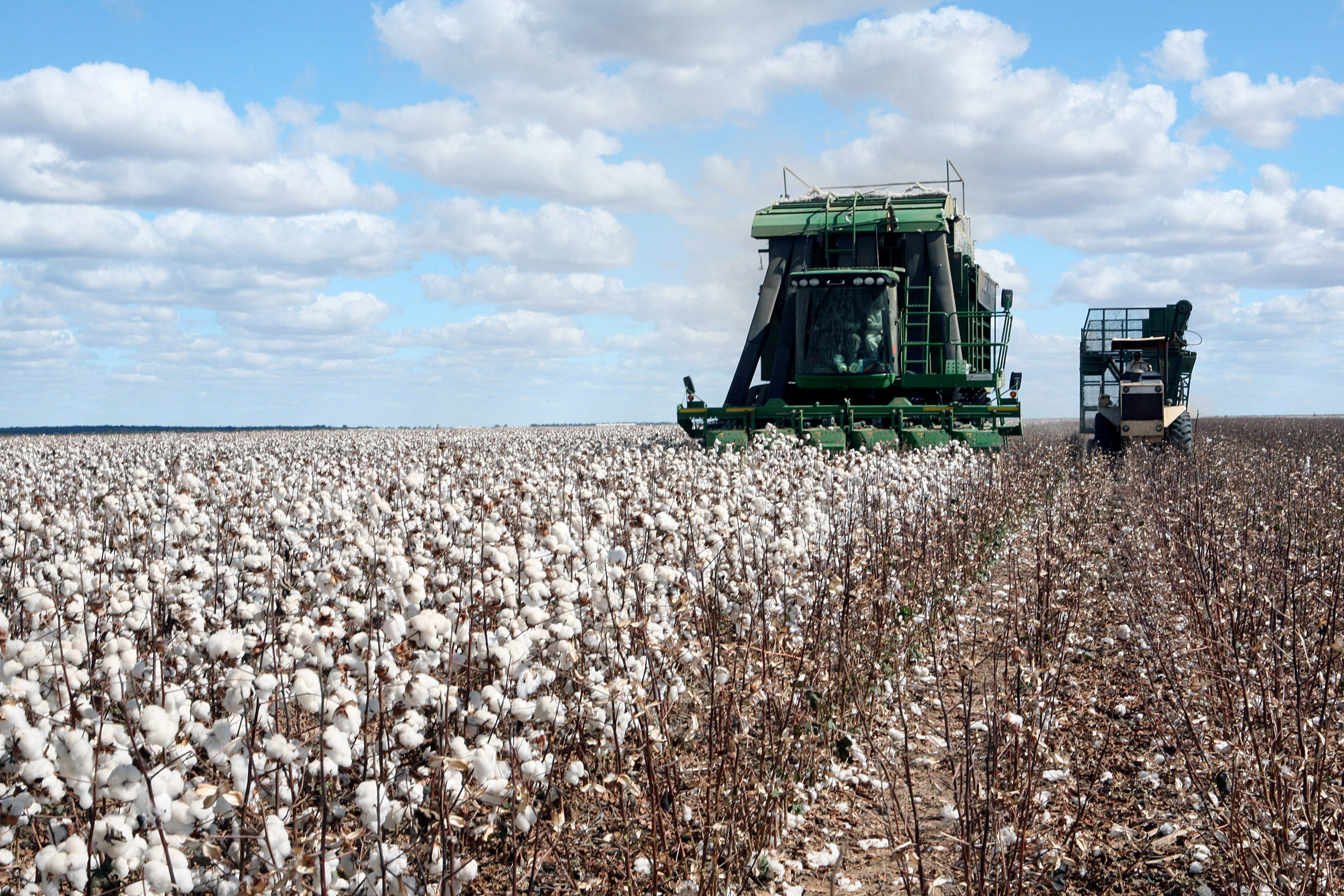
Harvest pressure will continue to play a role in the market over the next month. The USDA reported that the U.S. cotton harvest reached 16 percent last week, which compared to 19 percent the same week last year. Progress was ahead of the five-year average.
In non-market-related news, the USDA announced $531 million in grant funding to cover agricultural losses in Georgia following the aftermath of Hurricane Helene last year. The USDA and the state of Georgia are finalizing the agreement before administering funds through the Georgia Department of Agriculture.
— PAST PERFORMANCE IS NOT INDICATIVE OF FUTURE RESULTS. FUTURES TRADING INVOLVES SUBSTANTIAL RISK AND IS NOT SUITABLE FOR ALL INVESTORS.
Cotton futures steadied on Thursday but consolidated near key support levels. The latest round of export sales continued to disappoint the market, with total commitments holding at a nine-year low.
Cotton futures traded fairly steady on Thursday as prices consolidated above support levels. December cotton traded as high as 66.36 cents a pound before slipping back to unchanged by the afternoon. Futures have extended their downtrend since April, continually posting lower highs and lower lows.
So far, the major support area around 66 has held after rallying from the level in August and testing it in September. However, prices have been hugging the support area after slipping from their three-week high last week. There has been little reason for the market to reverse the current trend fundamentally. Additionally, harvest in the cotton belt could limit price gains.
The USDA’s latest export sales report brought more disappointing numbers this week. The agency reported that upland cotton export sales for the 2025/26 season fell to 86,100 bales, down from 186,100 bales the previous week. India was the top buyer for the week, followed by Turkey and Bangladesh. Sales to Vietnam declined significantly, which dragged total volumes lower. Total exports and commitments are running about 18 percent lower than the same week last year and are the slowest pace since the 2015/16 season.
There are signs of the global balance sheet tightening. Cotlook lowered its global surplus forecast for 2025/26 to 523,000 metric tons, compared to the previous estimate of 637,000 metric tons. The lower forecast was due to lower production expectations and higher consumption.
— PAST PERFORMANCE IS NOT INDICATIVE OF FUTURE RESULTS. FUTURES TRADING INVOLVES SUBSTANTIAL RISK AND IS NOT SUITABLE FOR ALL INVESTORS.
Cotton futures firmed on Tuesday, recovering part of Monday’s four-day decline. December cotton briefly traded 80 points higher to 72 cents a pound before easing back. Managed money added nearly 10,000 net-long contracts last week, but short covering quickly lost momentum as larger U.S. and global supplies continue to cap rallies.
Cotton futures found some buying interest on Tuesday after pushing lower for a fourth consecutive session on Monday. December cotton had traded about 80 points higher on Tuesday to 72 cents a pound before giving back half of the gains and closing at 66.59 cents.
Money managers were heavy buyers of cotton last week, with funds as net buyers of 9,844 cotton contracts. However, prices quickly faced pressure after the short-covering event.
Prices continued to trade in their sideways consolidation patterned established this spring. The 66-cent level remains the close support level. Larger U.S. and global supplies could continue to limit rallies.
The USDA’s Crop Progress report showed that the U.S. cotton harvest reached 12 percent complete as of Sunday, down one percentage point from the same week last year but on par with the five-year average.
U.S. cotton ratings slipped lower last week, with 47 percent of the crop in good-to-excellent condition, down five percent from the same week last year. Cotton conditions typically decline through harvest, but they remained the second best out of the last five years.
— PAST PERFORMANCE IS NOT INDICATIVE OF FUTURE RESULTS. FUTURES TRADING INVOLVES SUBSTANTIAL RISK AND IS NOT SUITABLE FOR ALL INVESTORS.
December cotton slid lower on Thursday and is testing minor support levels after a two-day selloff. USDA data showed export sales improved to 205,100 MT, though total commitments remain 20 percent below last year, with China absent from recent buying. Harvest pressure and muted export demand continue to cap upside potential.
Cotton futures sold off for a second day on Thursday, pushing prices back to support levels. December cotton traded about 0.60 cents lower to 66.60 cents a pound. The current level has served as support throughout the summer, though better support is around 66 cents.
Prices had risen to a two-week high earlier this week, though farmers selling physical bales likely added pressure as the week went on. To reiterate from Tuesday, harvest pressure could limit gains as more supplies come online over the next month.
The USDA’s export sales report on Thursday showed sales rebounded last week to 205,100 metric tons (MT), compared to 129,000 MT the previous week. Volumes were well above the same week last year but more on par with the five-year average. China was absent again on the sales sheet after two weeks of light purchases.
Total sales commitments and exports remained 20 percent below year-ago levels and are at the slowest pace since 2015. The recent break in the U.S. dollar is supportive for exports, but the lack of buying interest from China could mute exports.
Conab released its Brazilian crop production estimates this morning for the 2025/26 season. The agency forecasts cotton acreage to increase by 3.5 percent, driven by higher acreage in Bahia, Piaui, Minas Gerais, and the Tocantins. Total production is expected to increase 0.7 percent to a record 4.09 million metric tons.
—
PAST PERFORMANCE IS NOT INDICATIVE OF FUTURE RESULTS. FUTURES TRADING INVOLVES SUBSTANTIAL RISK AND IS NOT SUITABLE FOR ALL INVESTORS.
December cotton climbed to a two-week high on Thursday following last week’s WASDE report. While futures remain rangebound, harvest pressure and incoming supplies could cap near-term upside.
Cotton futures surged on Tuesday after breaking above last week’s highs
December cotton traded more than 0.60 cents higher on Tuesday to 67.44 cents a pound, a two-week high. Prices had been consolidating for the past few sessions.
Futures remain about mid-range within a broader sideways range established in the winter. Total volume has declined since earlier this summer as a lack of trading interest has kept prices rangebound.
The U.S. cotton harvest is underway, with nine percent of the harvest complete, compared to 10 percent the same week last year. Overall, weather conditions have been favorable for crops developing in the Southeast and in Texas.
Harvest pressure could limit gains as more supplies come online over the next month.
—
PAST PERFORMANCE IS NOT INDICATIVE OF FUTURE RESULTS. FUTURES TRADING INVOLVES SUBSTANTIAL RISK AND IS NOT SUITABLE FOR ALL INVESTORS.
The USDA left the U.S. cotton balance sheet unchanged in its September WASDE report, but tightened up the global balance sheet. December cotton futures finished 1.2 percent higher on the week.
The USDA’s September WASDE report brought little to no change for the U.S. cotton balance sheet.
The production estimate was raised slightly to 13.22 million bales due to marginally higher harvested acreage offsetting a slight yield reduction.
The 2025/26 ending stocks estimate was unchanged at 3.6 million bales, leaving the stocks-to-use ratio at 26.3 percent.
The global ending stocks estimate was lowered to 73.1 million bales, due to an 800,000-bale reduction. That was due to an increase in China’s production during the previous marketing year.
Global ending stocks are expected to be the lowest in four years after initially being projected higher than last year in the August report.
December cotton futures have been drifting higher this week, rising as high as 67.10 cents on Wednesday. Futures closed higher on Friday for the fifth consecutive session, ending the week 1.2 percent higher at 66.80 cents a pound.
—
PAST PERFORMANCE IS NOT INDICATIVE OF FUTURE RESULTS. FUTURES TRADING INVOLVES SUBSTANTIAL RISK AND IS NOT SUITABLE FOR ALL INVESTORS.
December cotton rebounded this week, avoiding a strong move below the major support of 66 cents. China bought small volumes of U.S. cotton for a third week. Brazil raised its cotton production estimate this month as the end of harvest nears.
Cotton futures traded higher for a fourth consecutive session on Thursday amid recovering export sales.
December cotton traded 0.20 cents higher by midday, nearly 67 cents a pound. Prices traded at the level for the first time in over a week.
Futures have so far avoided a strong move below the major support of 66 cents.
U.S. cotton export sales for the 2025/26 marketing year fell to 130,000 bales last week, compared to 245,000 bales the previous week. Net sales were above year-ago levels but well below the five-year average.
China showed up on the sales sheet this week, purchasing 17,600 bales of the total. Last week, they bought a fair amount of cotton relative to previous weeks. Total commitments remain well below the five-year average.
With over 90 percent of Brazil’s cotton harvest complete, Conab raised its 2024/25 production estimate to 4.1 million metric tons (MMT), up from the previous estimate of 3.9 MMT. That is expected to represent a nearly 10 percent increase from last season’s record.
Conab said weather conditions have been favorable this season and supported higher planted acres.
—
PAST PERFORMANCE IS NOT INDICATIVE OF FUTURE RESULTS. FUTURES TRADING INVOLVES SUBSTANTIAL RISK AND IS NOT SUITABLE FOR ALL INVESTORS.
December cotton hovered near long-term support around 66 cents, with prices vulnerable to further declines despite stronger export sales. Heavy fund short positions and incoming Texas harvest supplies continue to weigh on the market.
Cotton futures continued to hug the bottom end of their trading range this week after falling sharply last Monday.
December cotton traded moderately higher Tuesday morning at around 66.40 cents a pound. The level has served as a key support level since early March. Breaking below it makes prices vulnerable to testing the April 4 “Liberation Day” low of 64 cents.
Cotton prices are undoubtedly cheap. Price discovery has yet to occur before the market decides to move higher, which has left fund traders adding to short positions.
U.S. export sales improved last week, totaling a marketing-year high of 245,000 bales. Sales have improved over the past month, but poor sales ahead of the new marketing year have left total commitments well below the five-year average.
Farmers have begun harvesting cotton in Texas, with 19 percent of the state’s harvest completed. Incoming supplies to the market could continue to limit price gains over the next couple of months.
—
PAST PERFORMANCE IS NOT INDICATIVE OF FUTURE RESULTS. FUTURES TRADING INVOLVES SUBSTANTIAL RISK AND IS NOT SUITABLE FOR ALL INVESTORS.
The 2024/25 cotton marketing year wrapped up at the end of July. Highlighting the season were higher supplies, lower demand, and lower prices.
Trade
Exports account for about 84 percent of U.S. cotton demand, a historically high percentage, as production efficiencies outpace domestic demand. Still, exports largely declined since hitting a peak in the 2020/21 marketing year.
U.S. cotton exports finished the marketing year with 12.4 million bales shipped between August 2024 and July 2025, according to data from the U.S. Census Bureau. Total shipments were up 4.7 percent from the previous season, as demand from other countries helped offset lower purchases from China.
Vietnam was the most important market to help boost U.S. shipments over the past season, which more than doubled in 2024/25 and represented about 25 percent of total U.S. exports. Shipments to Pakistan rose 85 percent, driven by lower domestic production and strong consumption, while higher consumption lifted shipments to Turkey by 109 percent.
Notably, exports to China fell 83 percent from the previous season. Lower exports to China have been a result of the country’s high domestic production, large inventories, and weakening demand in the textile sector.
For the current 2025/26 marketing year, U.S. cotton export sales commitments are off to a slow start. Total commitments as of Aug. 28 reached 3.41 million bales, down 23 percent from the same pace last year. Commitments marked the slowest pace since the 2015/16 season.
Brazil has also had to diversify its cotton export program due to lower purchases from China. Brazilian cotton exports ended the marketing year at 13.24 million bales, up nearly eight percent from the previous season. The export campaign saw a nearly 200 percent increase to Pakistan, a 59 percent increase to Turkey, and a 46 percent jump in shipments to Bangladesh.
Brazil is forecast to export a record 14.1 million bales in the 2025/26 marketing year.
Brazil has been expanding its cotton acreage over the past few years. Targeting many of the same key markets could intensify competition for a shrinking pool of buyers.
U.S. Outlook
Weak economics and unfavorable weather are expected to drive 2025/26 cotton production down to 13.21 million bales, down 8.3 percent from the previous season. In August, the USDA cut its production forecast significantly due to higher expected abandonment in the Southwest.
The USDA estimates cotton ending stocks at the end of the 2024/25 marketing year totaled 4 million bales, up 27 percent from the previous season and the highest since 2019/20. The stocks-to-use ratio, which measures the relationship between supply and demand, is estimated at 29.4 percent. While not as high as it was earlier in the season, the high ratio signals current supplies are burdensome for demand, which has kept pressure on the cotton market over the past year.
U.S. cotton prices experienced lackluster price action throughout the 2024/25 marketing year. Futures have been stuck in a wide trading range since December, broadly contained by increasing global production and slowing domestic demand among key economies.
U.S. export commitments at a 10-year low signal further struggles for the market. Limited purchases from China will force exporters to compete for buyers in developing countries. Future trade dynamics will hinge heavily on China’s production and import needs, alongside demand from other major buyers.
—
PAST PERFORMANCE IS NOT INDICATIVE OF FUTURE RESULTS. FUTURES TRADING INVOLVES SUBSTANTIAL RISK AND IS NOT SUITABLE FOR ALL INVESTORS.
December cotton futures dipped down to support levels on Tuesday to start the holiday-shortened week. U.S. crop conditions have been relatively good for much of the growing season, while demand has been muted by the lack of sales to China.
Cotton futures are off to a weaker start this week after struggling to hold above a minor support level.
December cotton traded about 0.20 cents higher to 66.25 cents by the afternoon on Wednesday. Prices recovered slightly after trading 0.50 cents lower on Tuesday. Prices held above the 66-cent support level.
An acceleration to the downside on higher open interest and volume signals further potential weakness for the cotton market.
U.S. crop conditions have been relatively good for much of the growing season, while demand has been muted by the lack of sales to China.
U.S. cotton ratings declined three percent last week, with 51 percent of the crop in good-to-excellent condition. Ratings were still higher than the 44 percent good-to-excellent seen the same week last year.
Weather remains favorable for cotton filling in the Southeast and Texas. Twenty-eight percent of the crop had setting bolls, which is seven percent behind last year.
—
PAST PERFORMANCE IS NOT INDICATIVE OF FUTURE RESULTS. FUTURES TRADING INVOLVES SUBSTANTIAL RISK AND IS NOT SUITABLE FOR ALL INVESTORS.