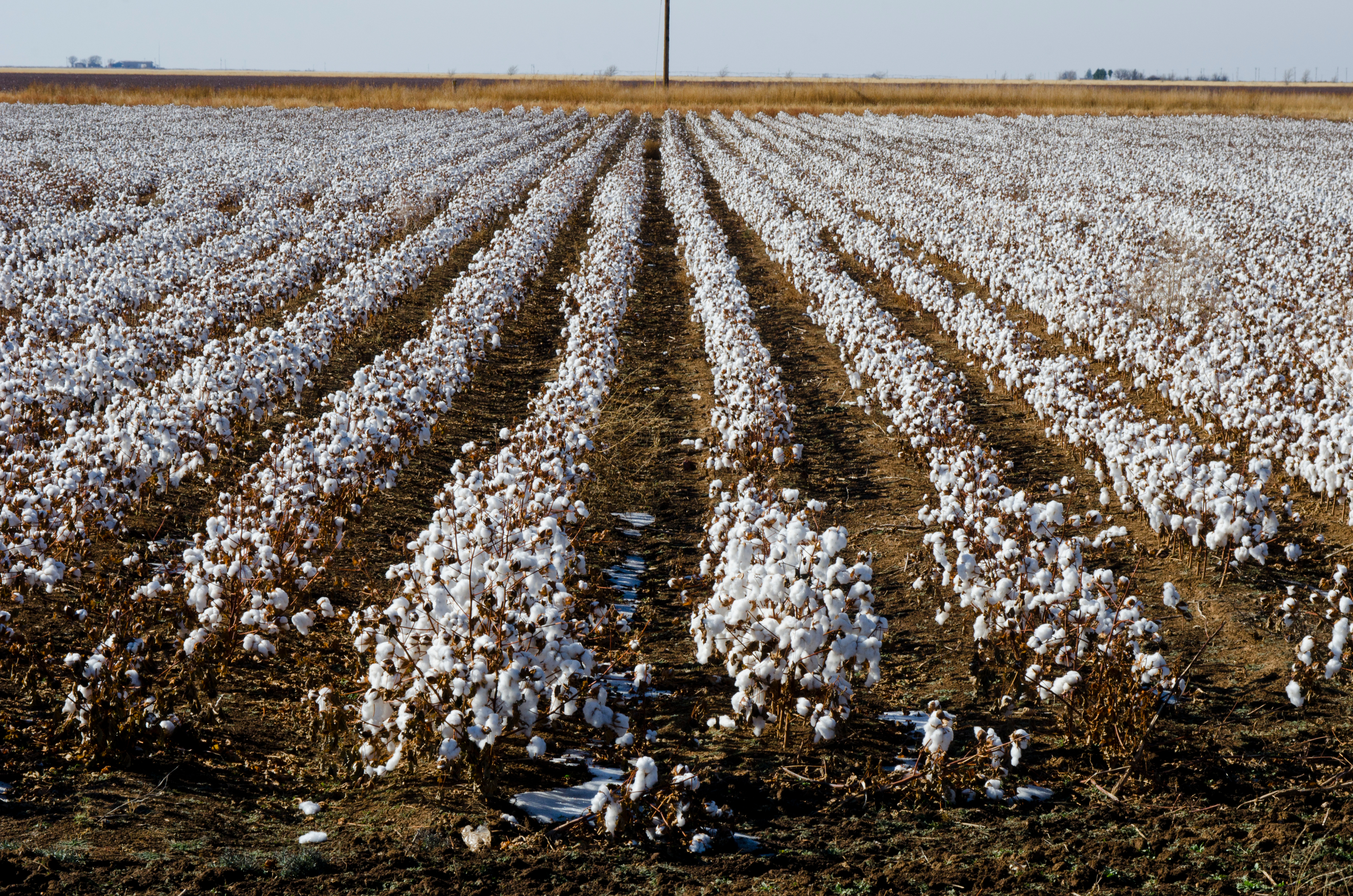
March cotton futures are hovering near contract lows around 64.45 cents as bearish sentiment persists. USDA export data showed sales and shipments running 17 percent below a year ago, while Brazil’s Conab kept its record crop forecast unchanged at 4.03 MMT.
Cotton futures are testing key support levels again this week after pieces failed to recover from last week’s lows. March cotton traded moderately lower Thursday morning to 64.60 cents a pound. Prices had traded as low at 64.57 on Wednesday, nearing the contract low of 64.45.
Speculators have likely been rolling short positions into the March contract as prices have struggled to reverse bearish sentiment.
Ahead of tomorrow’s WASDE report, traders expected the USDA to raise U.S. cotton production by 300,000 bales to 13.52 million, according to a Bloomberg survey this week. The export forecast could get a slight boost due to higher production and lower prices. Ending stocks are expected to increase from September by 160,000 bales. Global ending stocks are also expected to increase as production is expected to increase and consumption decrease.
The USDA resumed its export sales data reporting on Thursday after the government reopened. During the week ending Sept. 25, export sales for 2025/26 totaled 155,400 bales. Exports fell to 117,600 bales, compared to 137,200 bales the previous week. Total exports and commitments remained about 17 percent below a year ago at 4.2 million bales.
Exports and sales had been progressing well below seasonal averages before the government shutdown paused reporting. It’s assumed that the trend of lower export demand continued over the past month.
The agency said it will periodically release unpublished export reports that will take seven weeks before catching up to the normal schedule. Normal reporting won’t resume until Jan. 8, 2026.
Brazil’s National Supply Company (Conab) held its 2025/26 cotton production forecast steady this month at a record 4.03 million metric tons. Brazilian farmers won’t begin planting cotton until later this month. Conab said that soybean planting has been progressing under less-than-ideal conditions this season due to below-average rainfall for key areas.
—
PAST PERFORMANCE IS NOT INDICATIVE OF FUTURE RESULTS. FUTURES TRADING INVOLVES SUBSTANTIAL RISK AND IS NOT SUITABLE FOR ALL INVESTORS.
March cotton futures are testing major support near 65 cents after recent technical swings. Traders await Friday’s WASDE report and signs of stronger export demand as India’s record import outlook could boost global trade.
Cotton futures are trading at key levels again this week after a failed test of resistance two weeks ago. March cotton futures, which took over as the most active contract, traded moderately lower on Tuesday to about 65.60 cents a pound.
Prices are again testing their April 4 low of 65.56 cents a pound. Futures had accelerated losses below the level on Friday but quickly reversed those losses to begin this week. Major support remains at 64.45. A successful test of that level could encourage technical buying.
The USDA will release the WASDE report on Friday. Not much is expected to change on the demand side, though we might get some production revisions. The Senate passed its budget bill in a 60-40 vote, with the bill headed to the House before hitting the president’s desk. The potential of the government reopening this week could get us back on track with tracking export demand again.
Reuters reported that India could import about 4.5 million bales of cotton during the 2025/26 season. That would be a 10 percent increase from the previous season and a record. Domestic production is expected to hit a 17-year low, spurring the need for overseas imports.
India’s imports had already reached a record the previous season, driven by shipments from the U.S. Brazil, Australia, and Africa. India had already been increasing cotton imports from the U.S. over the past year. U.S. exporters could still face stiff competition from Brazil and Australia.
—
PAST PERFORMANCE IS NOT INDICATIVE OF FUTURE RESULTS. FUTURES TRADING INVOLVES SUBSTANTIAL RISK AND IS NOT SUITABLE FOR ALL INVESTORS.
Cotton futures retreated Friday, with the December contract falling below 64 cents and the March nearing contract lows. Rising open interest suggests renewed selling pressure amid weak export prospects and uncertainty over U.S. sales data. Brazil’s October cotton exports hit a record 294,000 tons.
Cotton futures resumed their decline late this week after failing to hold onto their one-month highs. The nearby December contract traded nearly 60 points lower by midday on Friday to just below 64 cents a pound. Prices traded below the old “Liberation Day” low of 64.24.
The March contract is becoming more active as first notice day approaches for the December contract. March prices are less than $1 away from their contract lows of 64.45 set on Oct. 14. Futures may still try to test that level before solidifying a bottom.
It will be difficult to tell if fund traders are adding length to their short positions this week due to the absence of the Commitment of Traders report. Rising open interest in the March supports the recent rejection of last week’s rally.
Fundamentally, the expectation of weaker export demand is bearish. Cotton has not been mentioned among the recent U.S. crop purchases by China. However, current U.S. export demand remains unknown due to the lack of the weekly export sales reports.
Meanwhile, Brazil’s cotton exports totaled 294,000 metric tons in October, up 4.6 percent year-over-year and a record for the month. Total shipments for the marketing year (Aug-Oct) are running about 2 percent behind last year following a slower start to the season.
—
PAST PERFORMANCE IS NOT INDICATIVE OF FUTURE RESULTS. FUTURES TRADING INVOLVES SUBSTANTIAL RISK AND IS NOT SUITABLE FOR ALL INVESTORS.
Cotton futures have been rangebound after last week’s one-month high, with December contracts testing resistance near 66 cents. Market attention is turning to next week’s WASDE report for potential production cuts, as drought limits U.S. yields. Global surplus forecasts have narrowed, though ending stocks are still projected to rise slightly year over year.
Cotton futures have been largely consolidating since hitting a one-month high last week. December cotton traded 42 points lower on Tuesday to 65.26 cents a pound. Prices continued to push lower after Monday’s moderate gains. Prices have been testing the 66-cent support level. That level may contain price gains due to the strong acceleration below support a month ago.
Cotton spreads have improved dramatically over the past month. It’s unknown if that has been due to commercial buyers stepping in at bargain prices. China has been reportedly making good will purchases of U.S. soybeans, though it’s unlikely the buying will extend to U.S. cotton.
Research firm Cotlook lowered its global cotton surplus forecast this month due to lower production estimates in the U.S. and Brazil. Consumption was also raised from last month’s estimate. The International Cotton Advisory Committee still expects global cotton ending stocks to be 2.5 percent higher than the previous season.
The U.S. cotton harvest is nearing completion, though the USDA is still not releasing the Crop Progress report due to the government shutdown. Drier conditions have been favoring the cotton harvest in west Texas and the Southeast.
The USDA said it will release the November WASDE report next Friday. The focus will be on production estimates, which could come in lower than the September report due to limited rainfall ahead of the harvest season.
Looking ahead to next season, government models have been pointing toward drier weather for much of the cotton belt. Eric Snodgrass with Nutrien Ag Solutions says there are going to be lingering risks for much of the South and Southeast all the way to next spring without any moisture.
—
PAST PERFORMANCE IS NOT INDICATIVE OF FUTURE RESULTS. FUTURES TRADING INVOLVES SUBSTANTIAL RISK AND IS NOT SUITABLE FOR ALL INVESTORS.
Cotton futures swung sharply this week as trade headlines drove renewed volatility. December cotton climbed above 66 cents on Wednesday before giving back gains overnight. While cotton wasn’t mentioned in Trump’s post-meeting comments, new trade deals with Southeast Asia could help offset weaker Chinese demand.
Cotton markets have been extremely volatile the past few sessions with the latest Trump-Xi news. Notably, cotton was not brought up in any of Trump’s post-meeting comments or media reports.
Again, weaker demand for textiles in China will continue to weigh on total U.S. exports. However, the Trump administration announced agreements with Southeast Asian countries Cambodia, Malaysia, Vietnam, and Thailand.
Southeast Asia has helped limit China’s absence in U.S. cotton exports. A deal with those countries could encourage additional buying.
December cotton futures traded 96 points higher on Wednesday to close at 66.01 cents a pound, the highest since late September.
Wednesday’s trade was followed by cotton taking back those gains overnight and into the morning. By midday on Thursday, the December contract traded more than 0.80 cents lower to about 65 cents.
A move above yesterday’s high puts the next area of resistance around 66.60, with support around 64.24. Prices need to gain another 3 cents to begin to reverse the current downtrend.
—
PAST PERFORMANCE IS NOT INDICATIVE OF FUTURE RESULTS. FUTURES TRADING INVOLVES SUBSTANTIAL RISK AND IS NOT SUITABLE FOR ALL INVESTORS.
Cotton futures climbed to their highest level in three weeks as traders exited short positions ahead of the Trump-Xi meeting. Hopes for progress on trade boosted sentiment, though weak global demand and resistance near recent highs could limit further gains.
Cotton futures extended recent gains this week, as prices moved further from their contract lows posted earlier this month. December cotton traded 49 points higher on Tuesday to close at 65.05 cents a pound, the highest close since Oct. 6. Traders exiting short positions have likely been a major driver of higher prices. There seems to be an unwillingness to be short in the market amid a potential deal between the U.S. and China.
Technically, futures climbing back above the old “Liberation Day” low of 64.24 is positive. However, prices could continue to struggle near the 65.87 level, which had served as previous support before seeking out new contract lows.
President Trump and President Xi are set to meet at the APEC meeting on Thursday. White House officials and counterparts in Beijing have already expressed a general consensus on trade negotiations, which could be finalized this week.
Cotton has gotten less attention than other commodities amid the latest tit-for-tat between the U.S. and China. Unfortunately, global cotton demand has been weaker than soybeans. The likelihood of China stepping in with large U.S. cotton purchases is lower than other commodities due to weak economic signals.
—
PAST PERFORMANCE IS NOT INDICATIVE OF FUTURE RESULTS. FUTURES TRADING INVOLVES SUBSTANTIAL RISK AND IS NOT SUITABLE FOR ALL INVESTORS.
Cotton futures rallied overnight before giving back gains early Monday morning, as traders covered short positions amid easing U.S.-China tensions. Officials are working to cool trade friction ahead of a planned meeting between Presidents Trump and Xi, but China’s cotton imports remain near 20-year lows, underscoring weak global demand.
Cotton futures surged overnight before quickly erasing losses ahead of the morning session. December cotton rose as high as 64.78 cents a pound overnight, the highest in over a week.
Prices were likely led higher by speculators covering short positions amid the uncertainty between the U.S. and China. White House officials have been trying to lower the temperature on the recent escalation between the two countries.
So far, President Trump and President Xi are set to meet in South Korea at the APEC meeting. A large focus has been on soybeans. However, China has been largely absent from global cotton trade, which the U.S. has relied on.
Chinese customs data on Monday showed that China’s cotton imports continued to run near a 20-year low. Volumes have been going back and forth between being the lowest since 2016 and data going back to 2004.
The lack of U.S. export data continues to be a concern, though there was a lack of interest from international buyers before the data was suspended. Cotton spreads increased significantly over the past week, suggesting that there could be some more commercial activity. The market has been waiting for a catalyst to lift it out of its rut.
—
PAST PERFORMANCE IS NOT INDICATIVE OF FUTURE RESULTS. FUTURES TRADING INVOLVES SUBSTANTIAL RISK AND IS NOT SUITABLE FOR ALL INVESTORS.
Cotton prices extended their slide this week, with December futures touching the lowest levels since the pandemic. A lack of fresh buying and missing export data amid the government shutdown have deepened uncertainty around demand.
This week marked fresh contract lows for the cotton market as a lack of willing buyers led to further selling. December cotton traded as low as 62.71 cents a pound on Tuesday, the lowest price for the December contract since the pandemic in 2020. Prices were mostly unchanged on Thursday, holding around 63.80. Near-term resistance is around the old support level of 64.22.
The December-March cotton futures spread strengthened considerably over the past week when December futures broke sharply lower. The latest selloff may have gotten over extended, but there has been little reason for buyers to step back in.
The lack of export data remains a challenge for understanding the demand picture. Exports are forecast to represent nearly 88 percent of U.S. cotton demand this season, a very large percentage historically.
Sometimes, significant bull spreading can suggest better export activity. The idea of improving exports won’t be confirmed until the government shutdown ends and USDA reporting restarts.
—
PAST PERFORMANCE IS NOT INDICATIVE OF FUTURE RESULTS. FUTURES TRADING INVOLVES SUBSTANTIAL RISK AND IS NOT SUITABLE FOR ALL INVESTORS.
December cotton fell to new lows as bearish momentum persisted and trade tensions between the U.S. and China pressured commodities. Speculative shorts dominate the market, with weak crude oil prices adding to the negative tone for global cotton demand.
Cotton futures continued their acceleration to new contract lows. December cotton traded 25 points lower on Monday to about 63.59 a pound, marketing a new contract low close for the market. Prices broke below their Apr. 4 “Liberation Day” low on Friday, posting new contract lows of 63.84 cents.
On Thursday, prices struggled to trade back above the 64.24 areas, which may now serve as resistance after being a long-term support level. Futures continued to confirm their bearish bias over the past week.
Friday’s tit-for-tat between the U.S. and China on Friday sent commodities and equities sharply lower as a risk-off mood overshadowed the market.
As stated last week, money managers are likely holding a record net short position following the recent washout. A short-covering rally could be limited by a strong bearish bias and the lack of bullish news for U.S. and global markets.
Weak crude oil prices are signaling economic weakness, which will likely hold weight over cotton, given their moderate positive correlation.
—
PAST PERFORMANCE IS NOT INDICATIVE OF FUTURE RESULTS. FUTURES TRADING INVOLVES SUBSTANTIAL RISK AND IS NOT SUITABLE FOR ALL INVESTORS.
Cotton futures maintained their bearish momentum this week as prices struggled to trade back above new resistance levels. December cotton is trading about 60 points lower around midday on Tuesday. Prices are currently testing last Wednesday’s low of 64.70 cents a pound. The next downside target would be the “Liberation Day” low of 64.24 if those levels fail to hold.
To reiterate from previous reports, speculators hold a historically large net short position as prices push to fresh lows. Strong commercial buying and bearish fundamentals have given traders little reason to reverse course on their short positions.
The lack of USDA data from the partial government shutdown has left the broader market in the dark. What we do know is that export sales have been dismal this season. Current commitments are running at the slowest pace since the 2015/16 season, according to the latest export sales report.
The lack of cotton exports to China has played a major role in the current weakness. China is importing cotton at the slowest pace in over 20 years, according to Chinese customs data tracked by Bloomberg. Last year, the country imported record volumes, led by early imports from the U.S., as well as large shipments from Brazil and Australia.
Pakistan is expected to import about 7 million bales of cotton this year due to flooding taking out a substantial portion of the crop this summer. However, that devastation hasn’t translated into larger U.S. sales since the country imported significant volumes from the U.S. and Brazil earlier this year.
Overall, the weather is favorable for cotton harvest. Some showers are impacting progress in the Southeast, though the forecast has been drier for West Texas. What is concerning is the growing moisture deficits in the cotton belt. The past 30 days have been much drier than average.
—
PAST PERFORMANCE IS NOT INDICATIVE OF FUTURE RESULTS. FUTURES TRADING INVOLVES SUBSTANTIAL RISK AND IS NOT SUITABLE FOR ALL INVESTORS.
December cotton futures tumbled this week, dropping nearly $1 on Wednesday as prices failed to trade above resistance and stop-running forced out weak longs. The market came close to retesting the “Liberation Day” low before rebounding, but resistance near 66 cents may cap upside.
This week’s cotton trade entailed new life of contract lows after a sharp drop below support on Monday and another sharp selloff on Wednesday. December cotton traded about $1 lower on Wednesday amid strong technical pressure as prices struggled to trade above a newly-established resistance level.
Yesterday’s stop-running likely washed out many weak long positions of traders attempting to pick a bottom. Additionally, uncertainty regarding the partial government shutdown could have added to selling pressure. Prices reinforced their downtrend this week after posting lower lows on the charts.
December prices came within 0.46 cents of the “Liberation Day” low on Wednesday before they reversed higher. Upward price action could be limited by the 66-cent level, which served as old support and is now a resistance level.
Speculators hold a historically large net short position as prices push to fresh lows. Strong commercial buying and bearish fundamentals have given traders little reason to reverse course on their short positions.
—
PAST PERFORMANCE IS NOT INDICATIVE OF FUTURE RESULTS. FUTURES TRADING INVOLVES SUBSTANTIAL RISK AND IS NOT SUITABLE FOR ALL INVESTORS.
Rapid crop expansion in South America, specifically Brazil, has challenged U.S. competitiveness over the past decade. Further expansion of South American acreage is expected to remain a headwind for U.S. crop markets in the upcoming 2025/26 season. Total crop output could reach a record 353.8 million metric tons (MMT), led by strong soybeans, corn, and…
Rapid crop expansion in South America, specifically Brazil, has challenged U.S. competitiveness over the past decade. Further expansion of South American acreage is expected to remain a headwind for U.S. crop markets in the upcoming 2025/26 season. Total crop output could reach a record 353.8 million metric tons (MMT), led by strong soybeans, corn, and cotton production.
Soybean planting growth continues
The U.S. and Brazil compete to meet global soybean demand, primarily through exports. Brazil’s soybean acreage is expected to increase by 3.6 percent in the upcoming season, according to Brazil’s National Supply Company (Conab). Brazil has accelerated its total soybean acreage over the past decade, averaging a 4.4 percent annual growth rate since 2014. In earlier years, some expansion was linked to deforestation in the Amazon, as clearing forest for cattle or crops was historically cheaper than developing already-cleared land.
However, the pace of direct deforestation for soy slowed significantly after 2006, following government enforcement measures and the soy moratorium signed by major grain traders. Since then, most soybean growth has come from converting underutilized pasture or fallow land, allowing production to continue rising despite policy changes.
Rural credit availability has played a significant role in the country’s grain expansion, resulting in a 205 percent increase in total crop output over the past 20 years. Government subsidies funded seed, fertilizer, and chemical inputs, as well as long-term investments in infrastructure, machinery, and technology.
Farmers took advantage of incentives to boost acreage and improve yields. This year, Conab forecasts soybean production to reach a record 178 MMT, up from the 2024/25 record of 171 MMT. Total production has increased 76 percent over the past decade.
Lower yields to cap higher corn acreage
Conab forecasts the 2025/26 corn crop one percent lower at 138.3 MMT. Acreage is expected to increase by 3.5 percent due to higher domestic demand, though yields are expected to offset the growth in plantings. Brazilian corn yields benefited from exceptional weather this past season, driving corn production to a record 140 MMT.
Due to its geography, Brazil’s agricultural production supports two corn crop seasons. The first season corn crop is planted from October to December and harvested from February to June. The crop accounts for 27 percent of Brazil’s total crop production.
Brazil’s second (winter) corn crop, also known as the Safrinha corn crop, is planted from January through February and into March. The winter corn crop planting takes place after the country’s soybean harvest, where the crop is primarily grown in Mato Grosso.
Brazil cotton production to set another record
Brazil’s cotton acreage has more than doubled over the past decade. Like corn, the country has a “Safrinha cotton” crop that allows farmers to maximize land use by planting cotton after the summer soybean harvest. Economic incentives, a favorable climate, and technological advancements have helped bolster cotton production over the past 10 years.
A profitable outlook for farmers is expected to drive higher cotton plantings this season. Conab forecasts cotton acreage to increase by 3.5 percent, driven by higher acreage in Bahia, Piaui, Minas Gerais, and the Tocantins. Total production is expected to increase 0.7 percent to a record 4.09 million metric tons.
Crop trade dynamics
Brazil’s soybean exports continued to progress at a rapid pace this calendar year, running 3.7 percent ahead of last year, according to Brazil’s Ministry of Development, Industry, Trade, and Services.
Brazil is expected to export a record 112 MMT during the 2025/26 season, driven by large supplies and strong demand from China. Large investments in Brazilian infrastructure have enabled China to become the primary beneficiary of the rapid expansion of soybeans in South America.
Brazil’s corn export growth stalled in recent years, primarily due to larger domestic usage for biofuel production. In August, Brazil’s corn exports totaled 6.85 MMT, up from a year ago. However, shipments between January and August are down 12.2 percent year-over-year and running at the slowest pace in four years.
The percentage of corn used in ethanol production has rapidly increased since the 2016/17 season. Domestic usage is likely to challenge exports amid supportive domestic policies for ethanol.
Brazil exported a record amount of cotton in the 2024/25 marketing year, totaling about 2.88 million metric tons, according to monthly trade data. Brazil’s cotton exports have backed off in recent months, as overall demand from China declined. Brazil has also had to diversify its cotton export program due to lower purchases from China.
The latest export campaign saw a nearly 200 percent increase to Pakistan, a 59 percent increase to Turkey, and a 46 percent jump in shipments to Bangladesh. Brazil is forecast to ship 3.1 MMT in 2025/26, surpassing U.S. exports for a third straight year, according to the USDA.
U.S. significance
Strong economic incentives propelled Brazilian crop production to new all-time highs over the past decade. Going forward, rural credit availability remains strategic not just for boosting output, but for steering expansion toward sustainable practices.
Continued investment in infrastructure, technology, and market access will likely sustain Brazil’s trajectory of record production across soybeans, corn, and cotton, further solidifying its position as a global agricultural powerhouse. Brazil’s record-breaking acres and dual-season crops are quietly rewriting the rules of global grain trade, forcing the U.S. to develop more partnerships and trade flows.
—
PAST PERFORMANCE IS NOT INDICATIVE OF FUTURE RESULTS. FUTURES TRADING INVOLVES SUBSTANTIAL RISK AND IS NOT SUITABLE FOR ALL INVESTORS.